An isometric miniature model of a British high street at golden hour: a brick terrace, an independent cafe with a deep green shopfront and warm lit windows, wet tarmac, a lit lamp post, and discarded paper receipts on the pavement.

The receipt problem

The receipt knows everything. Then it goes in the bin.

A receipt is the only record of what was actually bought — product, price, VAT. The bank never sees it, the shop cannot search it, and thermal paper fades to nothing in a drawer. Tapworth is a small NFC terminal that picks that data up at the till.

  • Item-level data
  • Discarded at the till
  • UK high street
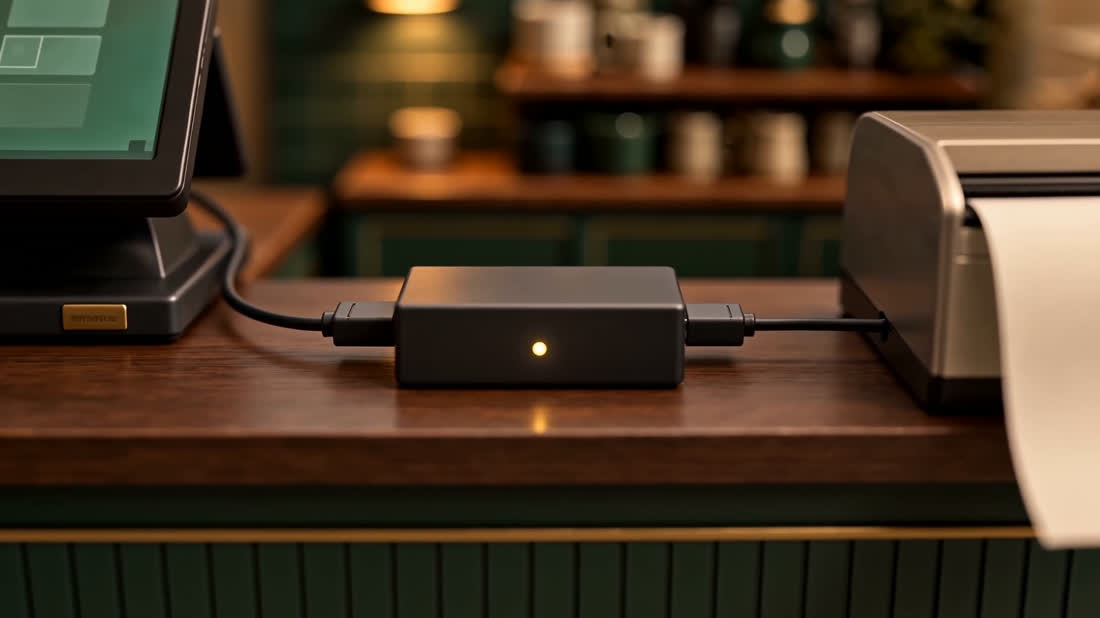
A cafe counter in miniature: a till on the left, a brushed-steel thermal receipt printer on the right with paper feeding out, and the flat matte dark Tapworth terminal lying on the walnut counter between them, a cable running in from the till and out to the printer.

The install

It goes between the till and the printer. That is the whole install.

One cable in, one cable out, on the leads the shop already has. No POS integration, no vendor certification, no engineer, no change to how anyone works the counter. And the receipt path is protected by wiring, not by a promise: a normally-closed relay means that if the terminal loses power or fails completely, the circuit closes straight through to the printer and the till keeps printing. A merchant cannot lose a sale because of us. That is why they let us inline the till at all.

  • Minutes to fit
  • Any POS
  • Prints even if we die
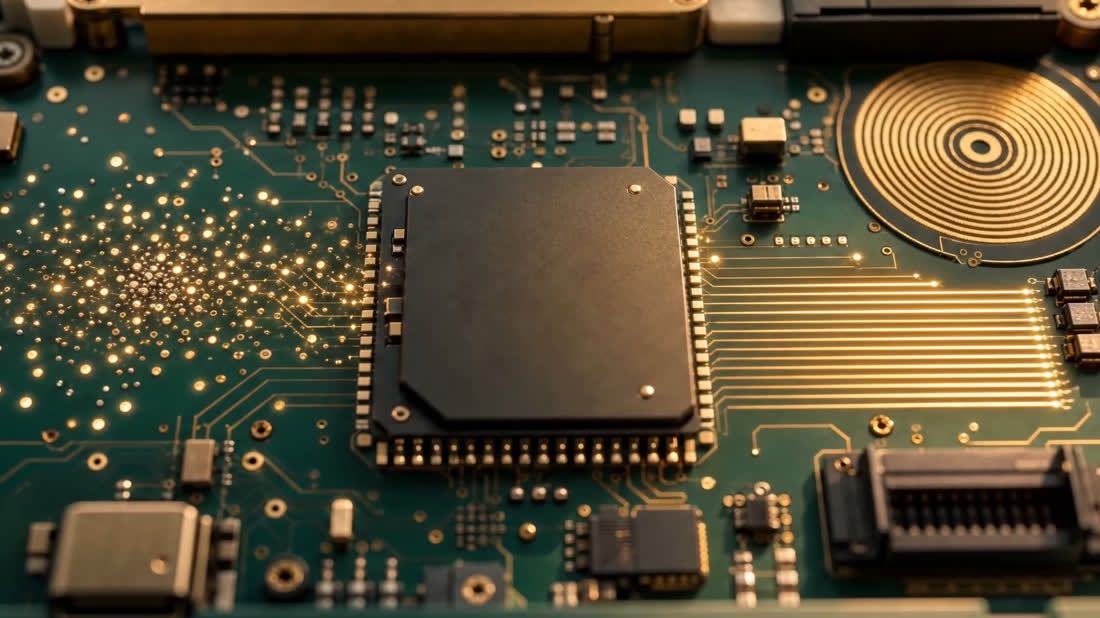
A macro view inside the terminal: a deep green circuit board with gold traces, a shielded chip at the centre, the flat spiral NFC antenna coil top right, and scattered points of light on the left resolving into ordered parallel lines on the right.

The capture

Every byte reaches the printer first. We read it on the way past.

The till already spells out every line of the receipt as ESC/POS commands, because it has to in order to print them — product name, quantity, unit price, VAT. The terminal forwards that stream onward the instant it arrives and parses it as a side effect of passing it on. The printer never waits for us. The POS is never asked for anything, which is why this works on a till we have never seen before.

  • ESC/POS
  • Forward-first
  • Structured in flight
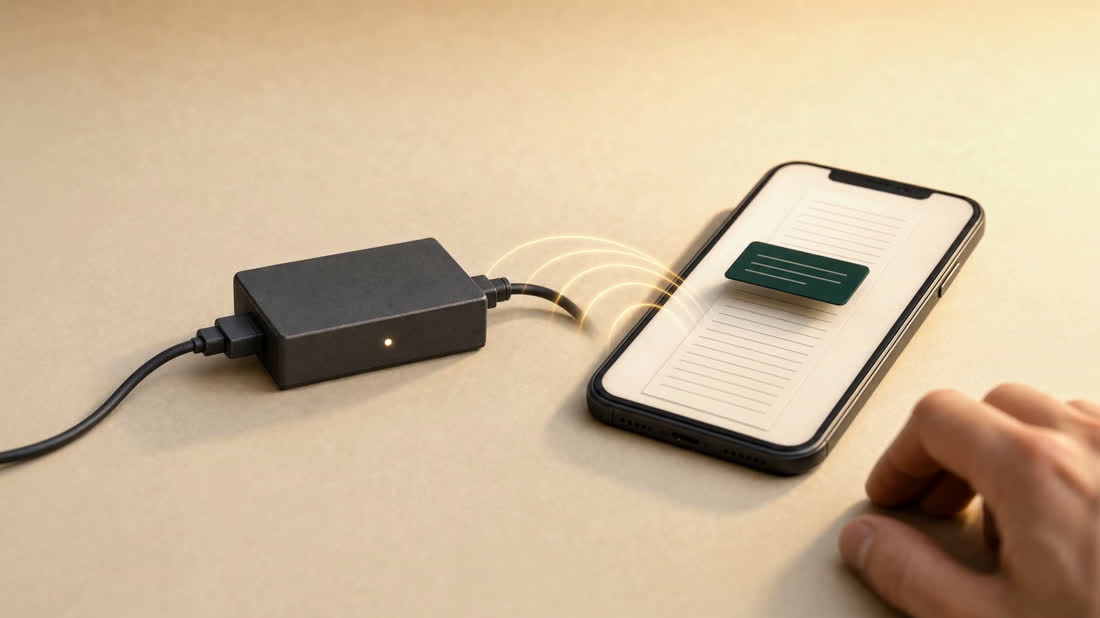
The flat Tapworth terminal on a table beside a phone lying flat. Arcs of gold light travel from the terminal to the phone, whose screen shows an itemised paper receipt with a notification panel above it.

The tap

They tap. It opens. There is no app.

The terminal emulates an NFC tag holding a one-time link, so the customer's phone opens the itemised receipt in the browser it already has — iPhone or Android, nothing to download, no account to create. The first tap is an anonymous wallet tied to that device; an identity only exists if they later choose to add one. Then the receipt starts doing work: warranties, return windows, price changes, subscriptions they had forgotten.

  • No app
  • No signup
  • Any phone with a browser
An isometric miniature city block at dusk, its streets dotted with points of gold light linked into a network, and a single ribbon of light rising from the centre and splitting into two branches against a sunset sky.

What the data becomes

Open banking sees “£47 at Tesco.” We see the 23 items inside.

That is the whole difference, and everything else follows from it. One capture at the counter becomes three things: a receipt wallet with an agent that acts on what it finds, a shop's own basket and demand intelligence in real time, and a financial identity for people whose credit file is empty. Same stream, three directions — and none of it is possible from a bank feed, because a bank feed never saw the items.

  • One capture
  • Three products
  • Item-level or nothing
See what a shop gets

Founding pilot shops are being fitted now.

A terminal, the install, and the full intelligence dashboard for the length of the pilot. If it is not telling you something useful in the first fortnight, we take it out again.

Read the spec first

For your shop

Things your till cannot tell you, from the receipts it already prints.

Most independent shops run the till as a cash register — it takes money and it prints paper. The same paper, read properly, answers the questions that actually decide a week.

  1. Stop binning food

    A seasonal-naïve seven-day forecast per product — literally “your last four Tuesdays” — printed as a prep sheet the kitchen can work from. Explainable in one sentence, which is why it gets trusted.

  2. Know what actually sells together

    Real basket analysis across every line item, plus daypart traffic and the attach opportunities hiding in it. Item-level, not “Groceries £47”, and live as receipts print.

  3. Keep the regulars you are about to lose

    A regular’s own median gap between visits, breached twice over, flags them while winning them back is still realistic. Cadence measured per person, not a blanket rule.

We never show a shop who its customers are. Merchant analytics are built from line items and aggregates; consumer annotations live in physically separate tables so that no careless query can leak them. Peer benchmarks only render when at least five shops sit in the comparison cell. A shop learns about its products, never about a person.

The receipt is already printed. We just stop throwing it away. Every line item, structured, as it prints

For your receipts

A wallet that reads the small print, and an agent that will go and argue about it.

Once something can see brands, quantities and prices, it can find what a bank statement never could — and then do something about it, at exactly the level of autonomy you allow.

The flat Tapworth terminal on a table beside a phone. Arcs of gold light travel from the terminal to the phone, whose screen shows an itemised paper receipt with a notification panel above it. One tap · no app

Subscription billed twiceSame service, two accounts, since March

Cancel

Warranty about to lapseBought 11 months ago, 30 days left

Claim

Cheaper two streets overSame product, a shop you already pass

Compare

Rang up above shelf priceYour last three receipts disagree

Dispute

On the most autonomous setting the agent still only runs reversible actions; anything irreversible waits for you, and every action is written to an audit log you can read. Warranty lengths are marked as estimated. Return windows are never guessed — policies vary by shop, and being wrong costs you a refund.

Photograph an old paper receipt and it parses into the same wallet, flagged as a lower-confidence source.

TapScore

A financial identity for people who have never borrowed.

A new resident, a freelancer, someone paid through an app — all of them can spend carefully for years and still be invisible to a lender, because the only thing a credit file records is borrowing. TapScore is built from observed purchase behaviour instead.

300–900 RE-DERIVABLE BY HAND
  • Stability

    Income-proxy regularity and how long the history runs.

  • Consistency

    Essential-versus-discretionary variance, month over month.

  • Capacity

    Discretionary headroom, and which way it is trending.

  • Reliability

    Subscription continuity, no sudden collapse in essentials.

Not a black box

Every score explains itself

Each response carries its own features, the number of receipts behind it and the window they cover — weighted toward recent behaviour, with a confidence interval that gets honestly wider the thinner the file is. A lender’s model-risk team can reproduce any score in a spreadsheet.

Consent is the gate

Per purpose, expiring, revocable

The API returns nothing until the person has approved that requester for that purpose. Consent is checked at the boundary on every single call, and it can be withdrawn. Enforced in code, not promised in a policy.

The terminal — TW-1

Small, cheap, and engineered so your till never depends on it.

Built from parts you can buy today: an ESP32-S3 for the dual serial path and a PN532 for NFC card emulation, which is what lets any modern phone read it from the home screen.

The flat matte dark Tapworth terminal lying on a cafe's walnut counter, a cable running in from the till on the left and out to the receipt printer on the right, which has pale paper feeding from it. TW-1 · inline on the printer cable
SitsInline, POS → printer
ProtocolESC/POS pass-through
TapNFC, ISO 14443 Type 4
CoreESP32-S3 + PN532
OfflineQueues locally, sends on reconnect
Failure modeRelay closes — printer keeps printing

The trust contract

If our hardware dies, printing continues. The relay is normally closed, so the default state of the circuit — unpowered, crashed, unplugged — is a direct POS-to-printer connection. Reliability is wired in rather than monitored.

Where we actually are

No pilot has run yet. Here is what does exist.

We would rather tell you this than show you numbers we invented. There are no usage figures on this page because there is no usage yet. What there is, is a finished platform you can be shown working, end to end, today.

404

automated tests in the backend suite, green — plus an end-to-end smoke suite on every build

3 apps

consumer wallet, merchant dashboard and the metered identity API, all built and deployable

0 pilots

no shop is live yet, and no revenue — founding merchants are being fitted now

EN / عربي

full Arabic and right-to-left support built in from the start, not retrofitted

Append-only

receipts are immutable events; every total, score and refund is derived and replayable

Integers

money is stored in minor units, never floats — the rounding class of bug cannot occur

Get in touch

Whichever side of the counter you are on.

Every form here goes to a real inbox. We reply to all of them, including the ones telling us we have got something wrong.

For shops

Join the pilot programme

A terminal, a five-minute install and the full dashboard for the length of the pilot. Cafés, delis, greengrocers, hardware shops — anywhere that prints receipts.

For customers

Get early access

Your receipts, itemised, searchable and working for you. Tell us where you shop and we will let you know when a terminal near you goes live.

For banks & lenders

TapScore API access

Underwrite thin-file and credit-invisible applicants against consented, explainable purchase behaviour. Sandbox keys and the scoring methodology on request.

Everything else

Press, partners, investors

Suppliers, integration partners, journalists, or an investor who found us through the product rather than a deck. Say which and we will send the right thing back.